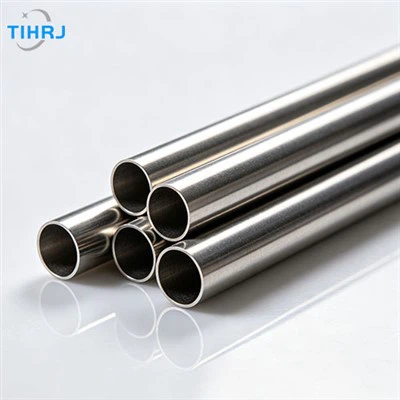
Titanium welded tubes are widely used in aerospace, chemical processing, marine, and medical industries due to their excellent corrosion resistance, lightweight properties, and high strength. Producing high-quality titanium welded tubes requires specialized processes and strict quality control. Here's a comprehensive overview of the manufacturing process and key considerations
1. Raw Material Preparation
Titanium Coil or Strip:
High-purity titanium (commonly grades such as Gr1, Gr2, Gr5) is supplied as coils or strips. The material must be clean, flat, and free from surface defects.
Surface Cleaning:
Before forming, the strip is thoroughly cleaned to remove oil, dirt, and oxidation. This is essential because titanium is highly reactive at high temperatures.
2. Tube Forming
Roll Forming:
The cleaned titanium strip is fed through a series of rollers, gradually shaped into a round (or other desired profile) tube.
Edge Preparation:
The edges of the strip are precisely aligned to ensure a uniform, tight seam for welding.
3. Welding
Welding Method:
The most common welding method for titanium tubes is GTAW (Gas Tungsten Arc Welding, also called TIG welding).
Sometimes, Laser Welding or Plasma Arc Welding is used for high-speed automated lines.
Shielding Gas:
High-purity argon gas is used to shield both the weld pool and the exterior surfaces from oxygen, nitrogen, and hydrogen. Titanium reacts easily with these gases at high temperatures, causing embrittlement.
Inside and Outside Shielding:
For thin-walled tubes, special attention is given to shielding the inside of the tube ("back purging") to prevent contamination.
4. Weld Seam Treatment
Inspection:
The weld seam is inspected visually and with non-destructive testing methods (such as X-ray, ultrasonic, or eddy current testing) to ensure there are no cracks, porosity, or inclusions.
Heat Treatment (if required):
Some tubes may undergo stress relief or annealing to improve ductility and remove residual stresses from welding.
5. Sizing and Straightening
The tube passes through further rollers to achieve precise dimensions and roundness.
Straightening machines ensure the tube is perfectly straight.
6. Cutting and Finishing
Tubes are cut to specified lengths using automatic cutting machines.
Deburring and end-finishing processes remove sharp edges and prepare the tube for further use.
7. Final Inspection and Quality Control
Mechanical Testing:
Yield strength, tensile strength, and elongation are checked to meet standards.
Dimensional Inspection:
Wall thickness, diameter, and length are measured precisely.
Surface Quality:
Tubes are inspected for surface defects, discoloration, or contamination.
Documentation:
Complete traceability records are maintained for each batch.
Summary Table: Titanium Welded Tube Manufacturing Steps
| Step | Key Points |
|---|---|
| Raw Material Prep | Clean, flat, defect-free titanium strip |
| Tube Forming | Roll forming into round tube, edge alignment |
| Welding | GTAW (TIG), laser, or plasma; high argon shielding |
| Weld Seam Treatment | NDT inspection, possible heat treatment |
| Sizing/Straightening | Achieve precise roundness and straightness |
| Cutting/Finishing | Cut to length, deburr ends |
| Final QC | Mechanical, dimensional, surface inspections |
Key Considerations
Shielding from air is critical throughout the welding process to prevent embrittlement.
Cleanliness and precision at every stage ensure the high corrosion resistance and mechanical properties of the finished tube.
Strict quality standards (ASTM, AMS, ISO, etc.) are followed for industrial and aerospace applications.
Conclusion
The manufacturing of titanium welded tubes is a sophisticated process that demands advanced technology, skilled operators, and rigorous quality control.
Proper shielding during welding, careful raw material handling, and thorough inspection are essential to ensure the tubes meet the demanding requirements of high-performance industries.
Need more details on titanium tube specifications or sourcing? Let me know your application for expert recommendations!