Your Professional Titanium Damascus Supplier
Baoji Hairuijie Metal Co., Ltd. is a leading supplier specializing in titanium exhaust pipe components, offering a wide range of models. Our clientele consists primarily of automotive modification enthusiasts from around the globe.
Standardized Production
We are capable of manufacturing and supplying products in compliance with international standards, including GB, ASTM, CEFR, GOST, and others.
Quality Certification
Baoji Hairuijie Metal Co., Ltd. has obtained ISO 9001 quality management system certification. We maintain a rigorous quality control and testing framework to ensure product excellence.
Custom Service
We offer tailored solutions to meet specific customer requirements.
Sales Market
Our products are exported to countries across Europe, America, Australia, Russia, Japan, Korea, and other regions worldwide.
-
![Titanium Mascus]() Titanium MascusProduct Name:Titanium MascusBrand Name:TIHRJPlace of Origin:Shaanxi Baoji China Packaging :Wooden PackagesPayment Terms:T/T, Trade Assurance,L/CType Of Shipping:By air/ By ocean /By railwayCertificates: ISO 9001:2015/EN10204 3.1read more
Titanium MascusProduct Name:Titanium MascusBrand Name:TIHRJPlace of Origin:Shaanxi Baoji China Packaging :Wooden PackagesPayment Terms:T/T, Trade Assurance,L/CType Of Shipping:By air/ By ocean /By railwayCertificates: ISO 9001:2015/EN10204 3.1read more

Specification
|
Processing Service |
Hot rolling, cold rolling, cutting, engraving |
|
Feature |
Low weight, low density, high strength |
|
Surface |
Frame pattern, nature color, burnt blue |
|
Shape |
Square, Round, Flat, disc, Customized Round Disc Titanium Damascus Rod Timascus Bar |
|
Density |
4.51g/cm3 |
Superior Strength-to-Weight Ratio
Titanium is eminent for its uncommon strength, bragging one the most noteworthy solidarity to-weight proportions of any metallic component. This intrinsic strength permits parts produced using titanium to endure weighty burdens and high anxieties while residual generally lightweight.
Corrosion Resistance
Titanium is inherently resistant to corrosion, particularly in environments such as seawater, acidic solutions, and high-temperature conditions. This resistance is attributed to the formation of a thin, protective oxide layer on the surface of titanium, which prevents further corrosion and degradation of the material.
Biocompatibility
Titanium is widely recognized for its biocompatibility, meaning it is well-suited for use within the human body without triggering adverse reactions or toxicity. When used in medical implants, such as orthopedic implants or dental implants, titanium fosters excellent integration with surrounding tissues and bones, promoting healing and minimizing the risk of rejection or infection.
Aesthetic Appeal
The aesthetic appeal of it cannot be overstated. The intricate, wavy patterns created by the layering and folding process are visually striking and unique to each piece. This makes it a popular choice for high-end consumer goods, such as luxury watches, jewelry, and custom knife blades.
Heat Resistance
Titanium's high melting point and excellent heat resistance make Titanium Damascus suitable for applications involving extreme temperatures. For example, in the aerospace industry, components made from it can withstand the high temperatures experienced during flight, without compromising strength or integrity.
Fatigue Resistance
Fatigue resistance is the ability of a material to withstand repeated stress cycles without failure. Titanium is renowned for its excellent fatigue resistance, and this property is retained in it. This makes the material ideal for components subjected to cyclic loading, such as those found in aircraft, automotive, and sports equipment.
Lightweight
The lightweight nature of it provides a significant advantage over heavier materials. In industries where reducing weight is critical to performance and efficiency, such as aerospace and automotive,it offers an optimal solution. Lighter components contribute to better fuel efficiency, faster speeds, and improved handling.
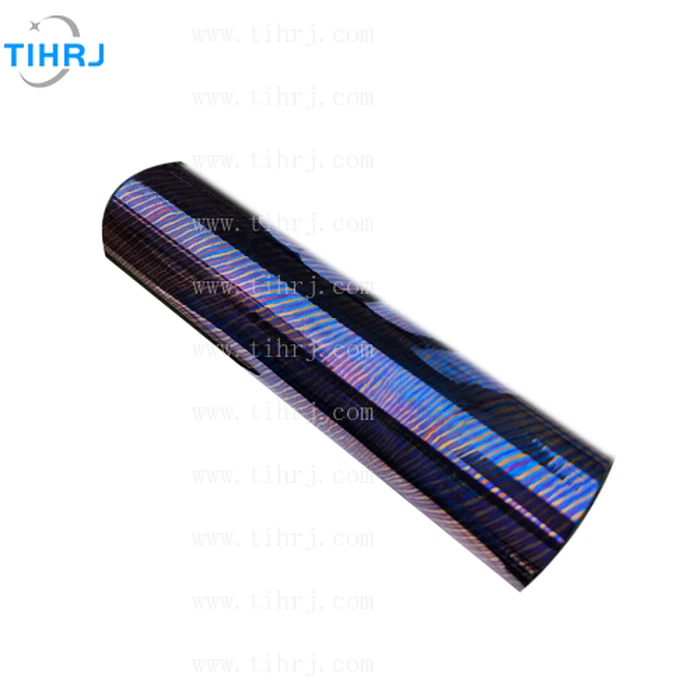
Titanium Damascus Process
Layering & Forge Welding
Selecting alloys with subtly different compositions ensures they will respond differently to etching and coloring processes. The precise stacking and diffusion welding create a solid, multi-layered billet from these distinct alloys.
Pattern Formation
Mechanical manipulation (twisting, carving, etc.) of the forged billet distorts the planar layers into complex, organic patterns that run throughout the material.
Pattern Revelation (Etching)
The patterned surface is treated with mild acids (like a mix of hydrofluoric and nitric acids). Because the different titanium alloys have slightly different resistance to etching, the acid removes material at slightly different rates, creating subtle variations in relief that make the underlying layered pattern visible before coloring.
Oxidation Coloring (The Magic)
This is where the vibrant colors appear. The polished or finished timascus surface is subjected to controlled oxidation:
● Heat Treatment (Flame Coloring/Burnishing): Heating the titanium in air to precise temperatures between 200°C and 600°C. Different temperatures grow titanium oxide (TiO2) layers of different thicknesses.
● Anodic Oxidation (Anodizing): Submerging the titanium in an electrolyte and applying a specific voltage (typically 20V to 100V). Different voltages grow oxide layers of different thicknesses. The transparent TiO2 layer causes light interference, producing color based on the layer’s thickness.
Comparison of Titanium Damascus with Other Materials
|
Feature |
Timascus |
Titanium Damascus |
Titanium Alloys |
Carbon Fiber |
|
Composition |
Titanium alloys |
Various steel types |
Pure titanium or titanium alloys |
Carbon fibers bonded with resin |
|
Corrosion Resistance |
High |
Moderate |
High |
High |
|
Weight |
Lightweight |
Heavy |
Lightweight |
Extremely lightweight |
|
Appearance |
Colorful, patterned |
Patterned |
Uniform, metallic |
Sleek, modern weave |
|
Strength-to-Weight Ratio |
Excellent |
Good |
Excellent |
Excellent |
|
Durability |
High |
Moderate |
High |
High but can degrade with heat |
|
Applications |
Custom knives, jewelry |
Knives, swords, decorative |
Aerospace, medical implants |
Automotive, aerospace, sports gear |
|
Cost |
High |
Moderate to high |
High |
Moderate to high |
Ordering Process

Packaging and Shipping
|
Packaging |
Wooden Packages |
|
Shipping |
DHL/FEDEX/UPS |
Our Factory
The company was established in 2017 and is located in Baoji City, Shaanxi Province, which is known as "China's Titanium Valley".

FAQ
We're professional martensite in titanium alloy manufacturers and suppliers in China, specialized in providing high quality customized service. We warmly welcome you to buy martensite in titanium alloy for sale here from our factory. Contact us for quotation.
-
![Titanium Flexible Exhaust Connector]() Titanium Flexible Exhaust ConnectorProduct Name:Titanium Flexible Exhaust ConnectorSize:2.0,2.5,3.0,3.5 inch,CustomizedKey Words:GR2 Titanium Flexread more
Titanium Flexible Exhaust ConnectorProduct Name:Titanium Flexible Exhaust ConnectorSize:2.0,2.5,3.0,3.5 inch,CustomizedKey Words:GR2 Titanium Flexread more -
![Titanium Straight Pipe]() Titanium Straight PipeWall thickness:1.0mm/1.2mmLength:1000~12000mm(normal size)Technique: Cold RolledBrand Name:TIHRJModel Number:read more
Titanium Straight PipeWall thickness:1.0mm/1.2mmLength:1000~12000mm(normal size)Technique: Cold RolledBrand Name:TIHRJModel Number:read more -
![Titanium Exhaust Elbow]() Titanium Exhaust ElbowProduct Name:Titanium exhaust elbowGrade:GR2 Titanium MaterialSpecification:2.0 inch /2.5 inch/3.0 inchModelread more
Titanium Exhaust ElbowProduct Name:Titanium exhaust elbowGrade:GR2 Titanium MaterialSpecification:2.0 inch /2.5 inch/3.0 inchModelread more -
![Titanium Block]() Titanium BlockProduct Name:Titanium BlockBrand Name:TIHRJStandard: ASTM B381/AMS 4928Application:Chemical Industry/Medicalread more
Titanium BlockProduct Name:Titanium BlockBrand Name:TIHRJStandard: ASTM B381/AMS 4928Application:Chemical Industry/Medicalread more -
![Titanium Exhaust Pie Cuts]() Titanium Exhaust Pie CutsProduct Name:Titanium Exhaust Pie CutsGrade: GR2 TitaniumSpecification:CustomizedBrandread more
Titanium Exhaust Pie CutsProduct Name:Titanium Exhaust Pie CutsGrade: GR2 TitaniumSpecification:CustomizedBrandread more -
![Gr2 Automobile Polishing Titanium Exhaust Elbow]() Gr2 Automobile Polishing Titanium Exhaust ElbowStandards Material: ASTM B338 (Titanium Seamless Tube) / ASTM B363 (Titanium Pipe Fittings –read more
Gr2 Automobile Polishing Titanium Exhaust ElbowStandards Material: ASTM B338 (Titanium Seamless Tube) / ASTM B363 (Titanium Pipe Fittings –read more