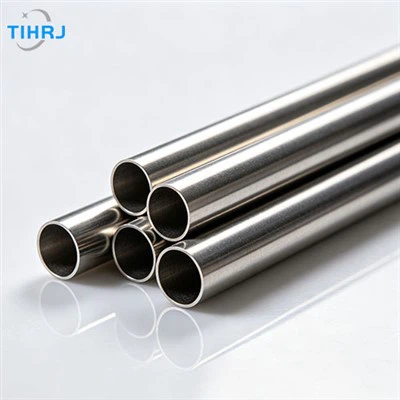
In the materials industry, titanium and titanium alloys are related, but they are not the same thing. The key difference is composition.
1) What "Titanium" means (pure titanium)
Titanium usually refers to commercially pure titanium (CP Ti)-titanium with a relatively small amount of other elements used mainly to control properties.
Common CP grades: Grade 1, 2, 3, 4 (often with small limits of impurities such as iron, oxygen, nitrogen, carbon, hydrogen).
Typical characteristics:
High corrosion resistance
Good formability and weldability
Lower strength compared with most titanium alloys (especially versus Ti-6Al-4V)
Industry takeaway: CP titanium is chosen when corrosion resistance/formability matters more than maximum strength.
2) What "Titanium Alloy" means (titanium + alloying elements)
A titanium alloy is titanium intentionally mixed with other elements (commonly aluminum, vanadium, molybdenum, tin, zirconium, etc.) to achieve higher strength, improved temperature capability, or tailored performance.
One of the most common alloys: Ti-6Al-4V (Grade 5)
(titanium + aluminum + vanadium)
Others include:
Ti-6Al-2Sn-4Zr-6Mo (Ti-6242 / Grade 21) (commonly for high-strength and high-temperature needs)
Ti-3Al-2.5V, Ti-5Al-2.5Sn, etc. (selected for cost/performance or specific corrosion/temperature needs)
Industry takeaway: Alloys are selected to get stronger and/or better performance in specific environments.
3) Practical property differences
Strength
Titanium (CP Ti): generally lower strength
Titanium alloys: generally higher strength (often much higher than CP Ti)
Corrosion resistance
Both can be highly corrosion resistant, but the choice depends on:
alloy composition
surface condition
temperature
and especially the environment (e.g., chlorides, crevices, deposits)
Density & weight advantage
Both titanium and titanium alloys have a similar fundamental advantage:
low density vs. steel and nickel alloys
So weight savings are available with both-strength level is the main differentiator.
Manufacturing and heat treatment
CP titanium is often simpler in terms of performance tuning (strength is controlled mostly by grade/purity).
Ti alloys may require heat treatment and strict quality control because microstructure (alpha/beta phases) strongly affects properties.
4) How engineers choose between them
Use this rule of thumb:
Choose CP titanium when the design priority is:
corrosion resistance
formability
and moderate strength requirements
(common in chemical processing, plating/acid environments, etc.)
Choose a titanium alloy when the design priority is:
higher strength-to-weight
fatigue resistance (often)
structural or performance needs
(common in aerospace, high-performance industrial parts, etc.)
One-line summary
Titanium (CP Ti) = relatively pure titanium; typically more formable and corrosion-focused, but lower strength.
Titanium alloy = titanium plus alloying elements; designed for higher strength and tailored mechanical/thermal performance.
If you tell me your application (e.g., chemical plant heat exchanger, seawater system, aerospace part, welding application), I can recommend which "type" (CP vs alloy) is usually preferred and why.