Hey there! As an elbows supplier, I've been dealing with all sorts of elbows on a daily basis. But today, I'm gonna switch gears a bit and talk about the biological side of elbows - specifically, the role of ligaments in the elbows. You might be thinking, "What does that have to do with the elbows I'm selling?" Well, understanding the biological function of elbows can actually give us a unique perspective on the design and application of the elbows we offer.
First off, let's get to know what ligaments are. Ligaments are tough, fibrous bands of connective tissue that connect bones to other bones. In the elbow, there are several important ligaments that play crucial roles in maintaining the stability and proper functioning of the joint.

One of the key ligaments in the elbow is the ulnar collateral ligament (UCL). This ligament is located on the inner side of the elbow. It's super important for people who do a lot of overhead throwing, like baseball pitchers. The UCL helps to resist the valgus stress that occurs when the elbow is extended and a force is applied to the outer side of the forearm. Without a strong and healthy UCL, the elbow joint would be prone to instability, and it could lead to serious injuries. For example, a UCL tear is a common and often career - threatening injury for pitchers.
Another important ligament is the radial collateral ligament (RCL). It's found on the outer side of the elbow. The RCL works in conjunction with the UCL to provide stability to the elbow joint. It helps to resist varus stress, which is the opposite of valgus stress. When you're doing activities like lifting heavy objects or performing certain types of weightlifting exercises, the RCL helps to keep the elbow joint in place and prevents excessive movement.
The annular ligament is also a significant part of the elbow ligament system. It forms a ring around the head of the radius bone. This ligament allows the radius to rotate smoothly during the movement of the forearm, such as when you turn your palm up or down. It's essential for the normal range of motion of the elbow and forearm.
Now, let's talk about how this biological knowledge relates to the elbows we supply. In the industrial world, elbows are used in a variety of applications, such as in exhaust systems. Just like ligaments provide stability and proper movement in biological elbows, our elbows need to be designed to ensure smooth flow and structural integrity in the systems they're part of.
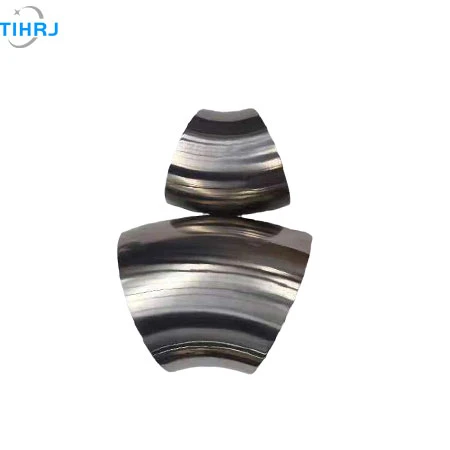
For instance, we offer high - quality Titanium 45 Degree Radius Elbow. This type of elbow is designed to change the direction of the exhaust flow at a 45 - degree angle. Similar to how ligaments guide the movement of bones in the elbow, our titanium elbows guide the flow of exhaust gases in a precise and efficient manner. The smooth inner surface of the titanium elbow reduces turbulence, which can improve the overall performance of the exhaust system.
Our Gr2 Titanium 90° Elbow is another great product. It's used when a more significant change in direction is required, like a 90 - degree turn. Just as ligaments prevent excessive and unwanted movement in the biological elbow, our 90 - degree elbows are engineered to maintain the structural integrity of the exhaust system even when there are sharp changes in the flow direction. The high - strength titanium material ensures that the elbow can withstand the high - pressure and high - temperature conditions in the exhaust system.
The Titanium 45° Radius Elbow is also a popular choice. It provides a balance between a moderate change in direction and efficient flow. The design of this elbow takes into account the need for smooth transitions, much like how ligaments allow for smooth movement in the biological elbow.
When it comes to choosing the right elbow for your application, it's important to consider factors like the angle of the turn, the material, and the flow requirements. Just as different activities place different demands on the ligaments in the biological elbow, different industrial applications have different needs for the elbows we supply.
If you're in the market for high - quality elbows for your exhaust system or other industrial applications, we're here to help. We have a wide range of elbows made from top - notch materials like titanium. Our team of experts can assist you in selecting the right elbow based on your specific requirements. Whether you need a 45 - degree or a 90 - degree elbow, we've got you covered.
We understand that reliability and performance are crucial in your projects. That's why we make sure that all our elbows are manufactured to the highest standards. Our titanium elbows are lightweight, corrosion - resistant, and have excellent strength - to - weight ratios. They can withstand the harsh conditions of industrial environments and provide long - lasting service.
If you're interested in learning more about our elbows or if you want to discuss a potential purchase, don't hesitate to reach out. We're always happy to have a chat and help you find the best solution for your needs. Whether you're a small - scale workshop or a large - scale industrial enterprise, we're here to serve you.
In conclusion, the role of ligaments in the elbows is to provide stability, support, and smooth movement to the joint. In the industrial world, our elbows play a similar role in guiding the flow and maintaining the integrity of systems. By understanding the biological function of elbows, we can better design and supply elbows that meet the diverse needs of our customers. So, if you're looking for top - quality elbows, give us a shout and let's start a conversation about your project.
References:
- "Gray's Anatomy: The Anatomical Basis of Clinical Practice"
- "Orthopaedic Knowledge Update: Sports Medicine"