As a trusted titanium rod/bar supplier, I often get asked about the maximum load a titanium bar can bear. This is a crucial question, especially for industries where strength, durability, and safety are paramount. In this blog post, I'll delve into the factors that determine the maximum load of a titanium bar, explore different types of titanium bars and their load - bearing capacities, and provide some practical insights for those considering using titanium bars in their projects.
Understanding the Basics of Load - Bearing Capacity
The maximum load a titanium bar can bear is determined by several key factors. First and foremost is the mechanical properties of the titanium alloy. Titanium comes in various alloys, each with its own unique set of characteristics. For example, the Ti6Al4V Eli Titanium Rod [Ti6Al4V Eli Titanium Rod]( /titanium - material/titanium - rod - bar/ti6al4v - eli - titanium - rod.html) is a popular choice due to its high strength - to - weight ratio, excellent corrosion resistance, and good weldability.
The yield strength and ultimate tensile strength are two critical mechanical properties when it comes to load - bearing capacity. The yield strength is the stress at which a material begins to deform plastically. Once the stress exceeds the yield strength, the material will not return to its original shape after the load is removed. The ultimate tensile strength, on the other hand, is the maximum stress a material can withstand before it breaks.
Another important factor is the cross - sectional area of the titanium bar. According to the basic principles of mechanics, the load a bar can bear is directly proportional to its cross - sectional area. A thicker bar will generally be able to bear a greater load than a thinner one. For instance, if you have two titanium bars of the same alloy but different diameters, the one with the larger diameter will have a higher load - bearing capacity.
The length of the bar also plays a role. Longer bars are more prone to buckling under compressive loads. Buckling occurs when a bar under compression suddenly bends or deflects sideways, which can lead to a significant reduction in its load - bearing capacity.
Types of Titanium Bars and Their Load - Bearing Capacities
Ti6Al4V Eli Titanium Rod
The Ti6Al4V Eli Titanium Rod is widely used in aerospace, medical, and automotive industries. It has a high yield strength, typically around 827 - 1034 MPa (120,000 - 150,000 psi), and an ultimate tensile strength of about 896 - 1103 MPa (130,000 - 160,000 psi). These high strength values make it suitable for applications where high loads need to be supported.
In aerospace applications, for example, Ti6Al4V Eli Titanium Rods are used in structural components such as landing gear and engine mounts. These components need to withstand extreme loads during takeoff, flight, and landing. The high strength - to - weight ratio of Ti6Al4V Eli Titanium Rods allows for the design of lighter yet strong structures, which is crucial for fuel efficiency and overall aircraft performance.
Titanium Exhaust Rod
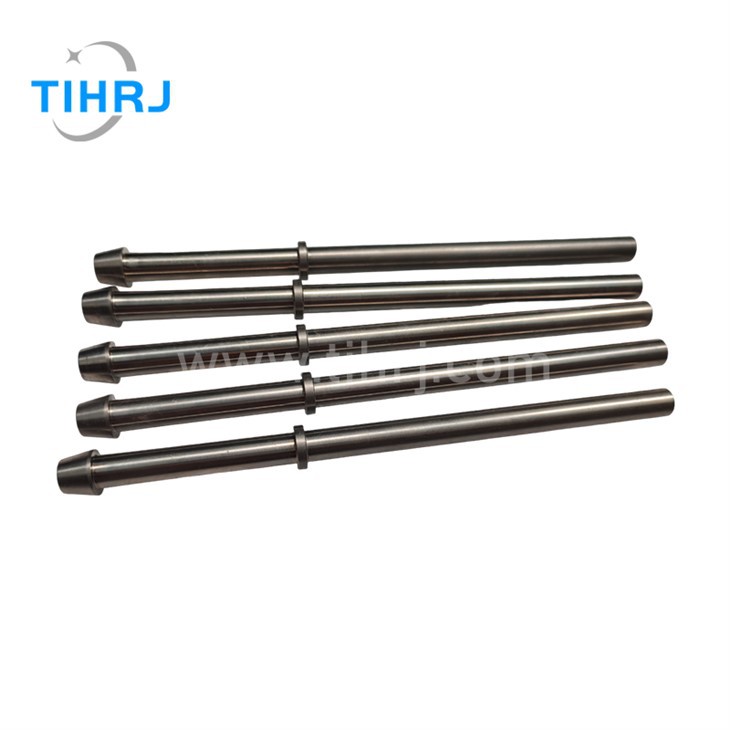
The [Titanium Exhaust Rod]( /titanium - material/titanium - rod - bar/titanium - exhaust - rod.html) is designed for use in exhaust systems. While it may not need to bear extremely high static loads like the Ti6Al4V Eli Titanium Rod in aerospace applications, it needs to withstand high temperatures and cyclic loads. Titanium has excellent heat resistance, which makes it an ideal material for exhaust rods.
The load - bearing capacity of a Titanium Exhaust Rod is also influenced by its geometry and the specific alloy used. The cyclic loads in an exhaust system, caused by the expansion and contraction of the exhaust gases, require the rod to have good fatigue resistance. Titanium's inherent fatigue resistance properties help the exhaust rod to maintain its structural integrity over a long period of time.
GR2 Titanium Hex Bar
The [GR2 Titanium Hex Bar]( /titanium - material/titanium - rod - bar/gr2 - titanium - hex - bar.html) is a commercially pure titanium bar. It has a lower strength compared to some of the alloyed titanium bars like Ti6Al4V Eli. The yield strength of GR2 Titanium Hex Bar is typically around 170 - 485 MPa (25,000 - 70,000 psi), and the ultimate tensile strength is about 240 - 550 MPa (35,000 - 80,000 psi).
However, GR2 Titanium Hex Bar has excellent corrosion resistance, which makes it suitable for applications in chemical processing, marine, and architectural industries. In these applications, the bar may not need to bear extremely high loads, but it needs to resist corrosion from various chemicals and environmental factors.
Calculating the Maximum Load
To calculate the maximum load a titanium bar can bear, we can use the following formula for axial tension or compression:
[F=\sigma\times A]
where (F) is the maximum load, (\sigma) is the allowable stress (usually taken as a fraction of the yield strength to ensure safety), and (A) is the cross - sectional area of the bar.
For example, if we have a Ti6Al4V Eli Titanium Rod with a yield strength of 900 MPa and a cross - sectional area of (100\space mm^{2}), and we assume an allowable stress of 0.6 times the yield strength (a common safety factor), the allowable stress (\sigma = 0.6\times900\space MPa=540\space MPa = 540\times10^{6}\space Pa).
The cross - sectional area (A = 100\times10^{- 6}\space m^{2}).
The maximum load (F=\sigma\times A=(540\times10^{6})\times(100\times10^{-6}) = 54000\space N)
It's important to note that this is a simplified calculation for axial loading. In real - world applications, the loading conditions can be much more complex, including bending, torsion, and combined loads. In such cases, more advanced engineering analysis methods, such as finite element analysis (FEA), may be required.
Practical Considerations
When using titanium bars in a project, it's essential to consider the actual loading conditions. For example, if the bar is subjected to dynamic loads, such as vibrations or impact loads, the fatigue strength of the titanium alloy needs to be taken into account. Fatigue failure can occur at stresses well below the ultimate tensile strength of the material.

Another consideration is the environment in which the titanium bar will be used. As mentioned earlier, titanium has excellent corrosion resistance, but in some aggressive environments, additional surface treatments may be required to enhance its corrosion resistance.
Conclusion
The maximum load a titanium bar can bear depends on various factors, including the alloy type, cross - sectional area, length, and loading conditions. Different types of titanium bars, such as the Ti6Al4V Eli Titanium Rod, Titanium Exhaust Rod, and GR2 Titanium Hex Bar, have different load - bearing capacities and are suitable for different applications.
If you're considering using titanium bars in your project and need to know more about their load - bearing capacities or other technical specifications, feel free to reach out to us. We are here to provide you with the best solutions and high - quality titanium rods and bars. Our team of experts can help you select the most appropriate titanium bar for your specific needs and assist you throughout the procurement process.
References
- Callister, W. D., & Rethwisch, D. G. (2017). Materials Science and Engineering: An Introduction. Wiley.
-ASM Handbook Committee. (2000). ASM Handbook, Volume 2: Properties and Selection: Nonferrous Alloys and Special - Purpose Materials. ASM International.