In the world of engineering, manufacturing, and various industrial applications, the terms "bend" and "arch" are often used, sometimes interchangeably, but they actually represent distinct concepts. As a supplier of bend products, I've had extensive experience dealing with bends, and I'm here to shed light on the differences between these two terms.
Defining Bend and Arch
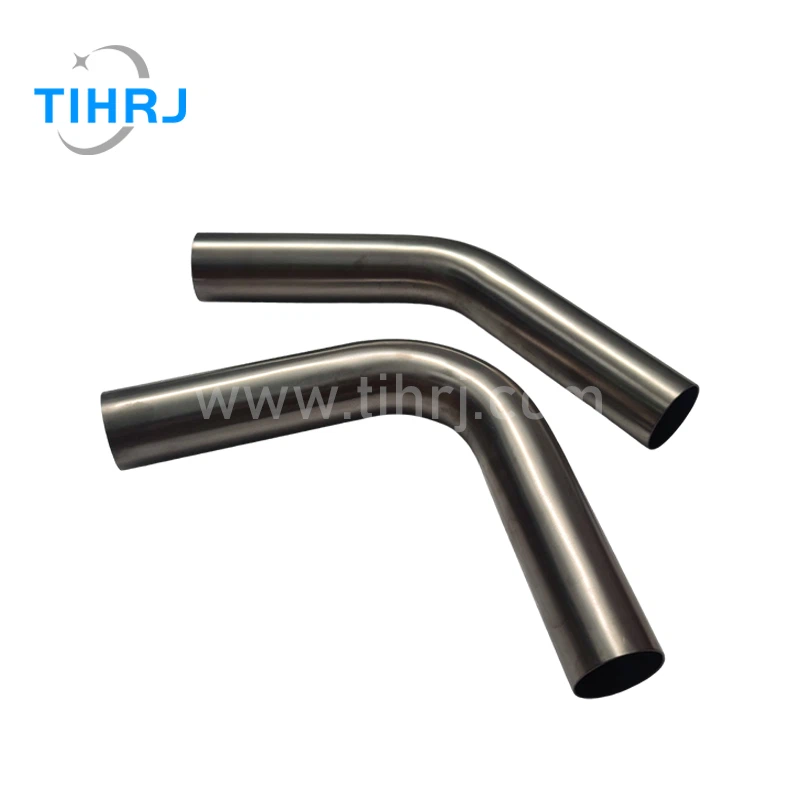
Let's start by defining what a bend is. A bend is a deformation of a material, typically a pipe, tube, or bar, where it is forced to change its direction along a specific radius. Bends are commonly used in a wide range of industries, from automotive exhaust systems to plumbing and construction. For example, in an automotive exhaust system, bends are crucial for routing the exhaust gases from the engine to the tailpipe efficiently. At our company, we offer a variety of bends, such as the Titanium 45° Mandrel Bend, 2.5″ Titanium 90 Degree Mandrel Bend, and Titanium 90° Mandrel Bend. These bends are precision - made to ensure smooth flow of exhaust gases and proper fitment in the exhaust system.
On the other hand, an arch is a curved structure that is typically self - supporting and designed to span an opening or support a load. Arches have been used in architecture for thousands of years, from ancient Roman aqueducts to modern - day bridges. The shape of an arch is usually a segment of a circle or an ellipse, and it distributes the weight or load it bears along its curve to the supports at its ends.
Geometric Differences
One of the most obvious differences between a bend and an arch lies in their geometric properties. A bend is essentially a local change in the direction of a linear object. It has a relatively small radius of curvature compared to the overall length of the object being bent. For instance, when bending a pipe, the bend might only cover a few inches or centimeters of the pipe's length, while the rest of the pipe remains straight.
In contrast, an arch has a more extended and continuous curve. It forms a significant part of the overall structure and is often designed to have a large radius of curvature. The curve of an arch is carefully engineered to transfer the load from the top of the arch to its abutments or supports. This requires a more complex geometric design compared to a simple bend.
Manufacturing Processes
The manufacturing processes for bends and arches also differ significantly. To create a bend, we use specialized bending machines. For metal pipes and tubes, mandrel bending is a common method. In mandrel bending, a mandrel is inserted into the tube to support the inner wall during the bending process. This helps to prevent the tube from collapsing or wrinkling on the inside of the bend. Our titanium bends are made using this precise mandrel - bending technique, which ensures high - quality and consistent bends.
The construction of an arch, however, is a much more involved process. In architecture, arches can be built using bricks, stones, or concrete. The stones or bricks are cut and shaped to fit together in a specific pattern to form the curve of the arch. In modern construction, pre - cast concrete or steel arches may be fabricated in a factory and then assembled on - site. The process requires careful planning and engineering to ensure the stability and strength of the arch.

Functional Purposes
The functional purposes of bends and arches are also distinct. Bends are mainly used for redirection. In fluid systems, such as plumbing or exhaust systems, bends are used to change the flow direction of liquids or gases. In mechanical systems, bends can be used to route cables, wires, or rods around obstacles.
Arches, on the other hand, are primarily used for load - bearing and spanning. They are designed to support the weight of the structure above them, such as the roof of a building or the deck of a bridge. Arches can also be used for aesthetic purposes in architecture, adding a sense of grandeur and elegance to a building.
Material Considerations
When it comes to materials, both bends and arches can be made from a variety of substances, but the choice of material is influenced by their different functions. For bends, materials are selected based on their ductility and corrosion resistance. In the automotive industry, titanium is a popular choice for exhaust bends because it is lightweight, strong, and resistant to high - temperature corrosion.
For arches, the material selection is more focused on strength and durability. In traditional architecture, stone and brick were used because they could withstand the heavy loads placed on the arch. In modern construction, steel and concrete are commonly used for their high strength - to - weight ratios and long - term durability.
Application Examples
Let's look at some real - world application examples to further illustrate the differences. In a home plumbing system, you'll find numerous bends in the pipes. These bends are used to route the water supply and drainage pipes around walls, floors, and other obstacles. The bends are typically made of copper or PVC, which are easy to bend and resistant to corrosion.
In contrast, consider a large - scale bridge. The bridge may have arches that span across a river or a valley. These arches are made of steel or concrete and are designed to support the weight of the bridge deck and the traffic passing over it. The arch design allows the bridge to be more stable and efficient in distributing the load compared to a straight - beam bridge.
Quality and Precision
In the production of bends, quality and precision are of utmost importance. A poorly made bend can cause problems in a fluid system, such as reduced flow rate, increased pressure drop, or leakage. At our company, we adhere to strict quality control measures to ensure that our bends meet the highest standards. We use advanced measuring tools to check the radius of curvature, the angle of the bend, and the wall thickness of the bent tube.
For arches, quality is also crucial, but the focus is more on the overall stability and load - bearing capacity. Engineers use sophisticated structural analysis software to design arches that can withstand the expected loads. During construction, strict quality control is maintained to ensure that the materials are properly installed and the arch is built according to the design specifications.
Conclusion
In conclusion, while both bends and arches involve curves, they are fundamentally different in terms of their geometry, manufacturing processes, functional purposes, material considerations, and applications. Understanding these differences is essential for anyone involved in engineering, manufacturing, or construction.
As a supplier of high - quality bend products, we are committed to providing our customers with the best - in - class bends for their specific needs. Whether you are in the automotive, plumbing, or any other industry that requires precise bends, we have the expertise and the products to meet your requirements.
If you are interested in purchasing our bend products or have any questions about our offerings, we invite you to contact us for a detailed discussion. We look forward to the opportunity to work with you and help you find the perfect bend solutions for your projects.
References
- "Engineering Mechanics: Statics and Dynamics" by J.L. Meriam and L.G. Kraige
- "Architectural Design and Construction" by Edward Allen and Joseph Iano
- "Fluid Mechanics" by Frank M. White