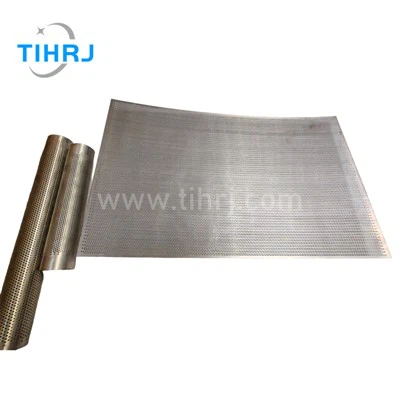
As a seasoned supplier of perforated products, I've witnessed firsthand the diverse and growing market demands for perforated membranes. These specialized membranes, characterized by their precisely engineered holes or perforations, find applications across a wide range of industries, each with its unique requirements and challenges. In this blog post, I'll delve into the key market demands for perforated membranes, exploring the factors driving their adoption and the specific applications where they excel.
Filtration and Separation
One of the primary applications of perforated membranes is in filtration and separation processes. In industries such as water treatment, chemical processing, and food and beverage production, the ability to separate solids from liquids or gases is crucial. Perforated membranes offer an effective solution by allowing the passage of fluids while retaining particles based on their size and shape.
The demand for high-quality perforated membranes in filtration applications is driven by several factors. Firstly, there is a growing need for more efficient and sustainable filtration solutions. With increasing environmental concerns and stricter regulations, industries are seeking ways to reduce waste and improve the quality of their products. Perforated membranes can provide precise control over the filtration process, resulting in higher purity levels and reduced energy consumption.
Secondly, the need for customized filtration solutions is on the rise. Different industries have specific requirements in terms of pore size, porosity, and material compatibility. As a perforated membrane supplier, I work closely with customers to develop tailored solutions that meet their exact needs. For example, in the pharmaceutical industry, where strict quality control is essential, we offer perforated membranes with extremely small pore sizes to ensure the removal of even the smallest contaminants.
Acoustic Applications
Perforated membranes also play a crucial role in acoustic applications, particularly in the automotive, construction, and audio industries. In automotive exhaust systems, for instance, perforated membranes are used to reduce noise levels by allowing sound waves to pass through the holes and dissipate. This not only improves the driving experience for passengers but also helps to meet regulatory requirements for noise emissions.
In the construction industry, perforated membranes are used in building facades and interior partitions to enhance acoustic performance. By controlling the size and distribution of the perforations, architects and designers can create spaces with optimal sound absorption and diffusion properties. This is especially important in environments such as concert halls, recording studios, and offices, where noise control is essential for comfort and productivity.
The demand for perforated membranes in acoustic applications is driven by the need for more advanced and effective noise reduction solutions. As urbanization continues to increase, the problem of noise pollution has become a major concern. Perforated membranes offer a cost-effective and sustainable way to mitigate noise levels without sacrificing aesthetics or functionality.
Fluid Distribution
Another important application of perforated membranes is in fluid distribution systems. In industries such as agriculture, irrigation, and oil and gas, the ability to evenly distribute fluids is crucial for efficient operation. Perforated membranes can be used to create porous pipes, tubes, and plates that allow for uniform fluid flow and distribution.
In agricultural irrigation systems, for example, perforated membranes are used to deliver water to crops in a controlled and efficient manner. By adjusting the size and spacing of the perforations, farmers can ensure that each plant receives the right amount of water, reducing water waste and improving crop yields. Similarly, in the oil and gas industry, perforated membranes are used in well completion and production operations to enhance fluid flow and recovery.
The demand for perforated membranes in fluid distribution applications is driven by the need for more precise and reliable fluid control. As industries become more competitive, the ability to optimize fluid distribution can lead to significant cost savings and improved productivity.
Biomedical and Biotechnology
In the biomedical and biotechnology industries, perforated membranes are used in a variety of applications, including cell culture, drug delivery, and tissue engineering. In cell culture, perforated membranes provide a support structure for cells to grow and proliferate, allowing for the exchange of nutrients and waste products. This is essential for the development of new drugs and therapies.
In drug delivery systems, perforated membranes can be used to control the release of drugs over a specific period of time. By adjusting the size and porosity of the membrane, pharmaceutical companies can ensure that drugs are delivered to the target site in a controlled and efficient manner. In tissue engineering, perforated membranes are used to create scaffolds for the growth of new tissues and organs, providing a framework for cells to attach and differentiate.
The demand for perforated membranes in biomedical and biotechnology applications is driven by the rapid advancements in these fields. As researchers continue to explore new ways to treat diseases and improve human health, the need for innovative and high-quality materials, such as perforated membranes, will only continue to grow.
Conclusion
In conclusion, the market demands for perforated membranes are diverse and growing, driven by a wide range of industries and applications. From filtration and separation to acoustic applications, fluid distribution, and biomedical and biotechnology, perforated membranes offer unique solutions to complex problems. As a perforated membrane supplier, I'm committed to meeting the evolving needs of our customers by providing high-quality products and customized solutions.


If you're interested in learning more about our perforated membranes or discussing your specific requirements, please don't hesitate to contact us. We'd be happy to work with you to find the perfect solution for your application.
References
- "Perforated Metal Products: Applications and Advantages." Metal Perforators Association.
- "Filtration and Separation Technologies in the Chemical Industry." Chemical Engineering Journal.
- "Acoustic Performance of Perforated Panels." Journal of the Acoustical Society of America.
- "Fluid Distribution Systems: Design and Optimization." Journal of Fluid Mechanics.
- "Biomedical Applications of Perforated Membranes." Biomaterials Science.