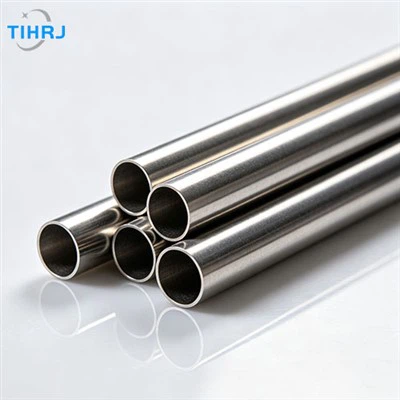
In recent years, with the vigorous development of automobile modification culture and the continuous improvement of consumers' demand for vehicle performance and personalization, the automotive modification industry has increasingly stringent requirements for material science. Among many innovative materials, titanium alloy has become the "darling" in the field of high-end modification due to its unique physical and chemical properties, and titanium tube, as a typical application form of titanium alloy, plays an irreplaceable role in power system optimization, lightweight design and durability improvement.
1. Material characteristics of titanium tubes: a double breakthrough in performance and aesthetics
Titanium alloy has become an ideal material for automobile modification due to its low density (only 60% of steel), high strength (close to high-strength steel), excellent corrosion resistance (far exceeding that of aluminum alloy) and high temperature resistance (stable operation at 600°C). For example, the exhaust system made of titanium tubing can reduce the wall thickness by more than 30% compared with traditional stainless steel, but can withstand higher exhaust pressure and temperature fluctuations. According to the test data of a well-known Japanese modification brand, after the use of titanium alloy exhaust pipe, the engine exhaust back pressure is reduced by 15%, and the power output is increased by about 5%, while the exhaust sound presents a unique metallic texture, which has both functionality and auditory aesthetics.
2. Key application scenarios: from power improvement to safety upgrade
Exhaust system revolution:
The application of titanium pipes in exhaust manifolds, middle and tail sections significantly improves exhaust efficiency. The titanium alloy variable valve exhaust system developed by Milltek Sport in the United Kingdom can reduce the weight by 40% through the 3D printed titanium tube structure, and the torque of the turbocharged model can be increased by 8%-12% with ECU tuning.
Suspension and transmission system:
In the competition-level modification, the anti-roll bar and drive shaft made of titanium tubes reduce the unsprung mass by 25% while ensuring strength, directly improving the vehicle's handling response speed. The track version of the Porsche 911 GT3 RS uses a titanium propamine to reduce the 0-100 km/h acceleration time by 0.3 seconds.
Turbocharging system:
In the high-performance retrofit solution with a boost value of more than 2.5 bar, the titanium alloy pressurized pipe can withstand a continuous high temperature of 800°C, avoiding the creep problem of traditional aluminum alloy pipes. Measurements by BorgWarner in the United States show that the titanium tube boosting system reduces turbo lag by 20%.
3. The balanced evolution of economic and environmental protection values
Although the initial cost of titanium tubing is 5-8 times that of 304 stainless steel, its life cycle cost advantage is significant. According to the German TÜV certification data, the service life of the titanium exhaust system can reach 15 years under severe working conditions, which is more than 3 times that of the stainless steel system. In terms of environmental protection, the carbon emissions in the production process of titanium tubes are reduced by 30% compared with traditional materials, and the 100% recyclability characteristics are perfectly in line with the requirements of the EU ELV directive. Tesla's Cybertruck retrofit market has seen a titanium alloy battery cooling pipe solution, which can improve thermal management efficiency while reducing the weight of the system by 12kg.
4.The future trend: intelligent manufacturing to promote the popularization of applications
With the breakthrough of laser welding, powder metallurgy and other technologies, the processing cost of titanium tubes is declining at an average annual rate of 7%. The thin-walled titanium tube (wall thickness 0.5mm) developed by China Baoti Group has achieved large-scale production, and the cost is controlled within 300 yuan/meter. The application of 3D printing technology has also led to the emergence of titanium tube components with topology-optimized structures, such as the swing arm connecting tube with honeycomb hollow structure, which further reduces weight while ensuring strength.
At the moment when automobile modification is transforming from "appearance dazzling" to "performance revolution", titanium tube has broken through the niche modification field and gradually penetrated into the civilian market. According to Frost & Sullivan's forecast, the global market size of titanium tubes for automotive modification will exceed US$2.2 billion by 2027, and the compound growth rate of the Chinese market is expected to reach 18.6%. This material, which combines technology and industrial aesthetics, is redefining the performance boundaries of modern car tuning.