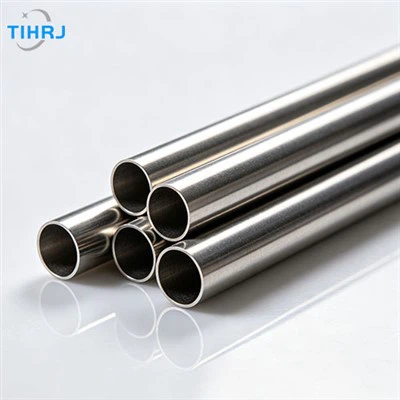
In the selection of materials for industrial piping systems, the choice of materials is far from a simple comparison of specifications, but a precise calculation of safety, efficiency and cost.
As the "blood vessel" of industrial production, the choice of material directly affects the life, safety and economic benefits of the entire system. Among the many pipe fitting materials, titanium pipe fittings and stainless steel pipe fittings have become the first choice for many industries due to their excellent properties. Titanium pipe fittings are known for their excellent corrosion resistance and high strength-to-weight ratio, especially suitable for harsh environments. Stainless steel pipe fittings occupy a wide range of application markets with their mature processes and cost advantages.
Scientific comparison of material properties
The essential difference between titanium pipe fittings and stainless steel pipe fittings stems from the physical and chemical properties of the material itself. The most outstanding feature of titanium is its perfect combination of low density and high strength. Titanium has a density of about 4.5 g/cm³, which is only about 57% of the density of stainless steel (7.7-8 g/cm³), but its strength is comparable to that of steel. This high specific strength characteristic makes titanium pipe fittings unmatched in applications where weight reduction is required, such as in aerospace, where every kilogram of weight saved translates to a substantial fuel efficiency improvement.
Corrosion resistance is another key differentiator. Titanium fittings exhibit excellent corrosion resistance in most acid-alkali environments, especially with greater resistance to seawater and chloride solutions. Titanium has a high affinity for oxygen, which can form a dense oxide film on its surface to protect titanium from media corrosion, which makes it last far longer than stainless steel in chemical and marine environments.
In terms of high-temperature performance, titanium pipe fittings can still maintain good strength and stability in an atmosphere of 500°C, and have good low temperature resistance, even at ultra-low temperatures of -250°C. Although certain grades of stainless steel (such as 316L) can also work in a certain high temperature environment, the overall high temperature resistance is still not as good as titanium alloy.
Fatigue strength is another advantage of titanium fittings. Titanium tubes have high fatigue strength, allowing them to excel under dynamic load conditions, which is particularly important for critical components in the aerospace and automotive industries.
Specific analysis of industry applications
Different industries have completely different considerations in the selection of pipe fittings due to differences in working environment, media nature and cost sensitivity.
In the aerospace industry, weight reduction and reliability are top considerations. Titanium pipe fittings are ideal for fuel systems, hydraulic systems, and engine piping due to their excellent strength-to-weight ratio and corrosion resistance. This reduction in aircraft weight translates directly into improved fuel efficiency and increased payload, making the return on investment significant even if titanium fittings are expensive. At the same time, the good high-temperature properties of titanium allow it to adapt to the high-temperature environment around the engine.
The chemical and petroleum and petrochemical industries are another important application area for titanium pipe fittings. In these industries, pipelines often have to transport highly corrosive media, such as chloride ions, acidic substances, etc. Titanium pipe fittings can "better resist the erosion of chloride ions", and titanium pipes have become an ideal choice for solving corrosion problems in chemical projects such as ion membrane caustic soda production, formic acid, acetic acid, and propylene oxide.
In the pharmaceutical and food processing industries, hygiene standards and contamination-free requirements are extremely strict. 316L stainless steel pipes have become a mainstream choice in these industries due to their good corrosion resistance and hygienic standards. Titanium fittings offer the advantage of being biocompatible (a property taken advantage of in the medical implant sector), but stainless steel can meet most needs in general pharmaceutical and food processing environments at a more manageable cost.
The fields of marine engineering and desalination present a more complex picture of material selection. 316L stainless steel performs well in general seawater environment, but its chloride ion corrosion resistance is limited. Titanium pipe fittings excel in this regard, making them the preferred choice for high-end marine applications. In desalination plants, titanium welded pipes can last more than 20 years, far exceeding other metal materials.
Practical considerations of cost and processing technology
The price of titanium pipe fittings is significantly higher than that of stainless steel pipe fittings, and according to industry data, the price of titanium pipe is at least 15 times that of stainless steel pipe. This price difference is mainly due to the difficulty of smelting and processing titanium. Titanium must be treated with bright solution, and the precision requirements and weld quality requirements of the pipe are higher than that of stainless steel pipe.
In terms of processing technology, the welding of titanium pipes requires special welding methods (such as plasma arc automatic welding) to ensure the quality of the weld. Titanium tubes have a high flex-elastic ratio, and the rebound is obvious when bending, and excessive rebound makes it difficult to control the geometry and precision of the tube. The welding and processing technology of stainless steel pipes is more mature, and the connection methods are diverse (such as double clamping connection, welding, etc.), making installation and maintenance more convenient.
However, if analyzed from a lifecycle cost perspective, the investment in titanium pipe fittings can often be compensated in use. Titanium pipes reduce long-term production costs by reducing the number of regular maintenance, reducing downtime, and improving pipe life. Especially in corrosive environments, stainless steel pipes may need to be replaced frequently, while titanium pipes can maintain long-term stable operation.
The price of large-diameter titanium welded pipe is 40%~60% lower than the price of titanium seamless pipe of the same specification, which provides a compromise solution for applications with limited budget but requiring excellent titanium properties.
Material selection guidelines in special environments
In high-chlorine environments (e.g., seawater cooling systems, coastal chemical plants), titanium fittings are significantly better than stainless steel. The corrosion rate of 316L stainless steel in chloride ion environments is more than 5 times that of titanium. In this environment, even if the initial investment is higher, it is often more economical to choose titanium pipe fittings because it avoids downtime and replacement costs due to pipeline corrosion failure.
The selection of materials in high-temperature and high-pressure environments needs to be more careful. Titanium pipe fittings can still maintain good strength stability at a high temperature of 500°C, while most stainless steels will lose strength above 300°C. For heat exchange systems and high-temperature process piping, titanium may be the only viable metal option.
For medical and bioengineering applications, both materials have their merits. Titanium tubes are biocompatible and do not cause rejection by the human immune system, making them one of the preferred materials in the manufacture of implantable medical devices and orthopedic implants such as artificial joints. Stainless steel, especially 316L, is widely used in medical gas delivery systems and external medical equipment because it can meet hygiene requirements and is relatively controllable.
In extremely low-temperature environments (such as LNG facilities and superconducting applications), titanium pipe fittings show obvious advantages, maintaining high impact strength at ultra-low temperatures of -250°C, and can withstand high pressure and vibration. Most stainless steels become brittle in extremely low temperature environments, which poses safety hazards.
Future trends and innovation directions
With advancements in material science and manufacturing techniques, the competitive landscape between titanium and stainless steel pipe fittings is quietly changing. The development of large-diameter titanium welded pipe technology is lowering the application threshold of titanium pipe fittings.
Traditionally, the production of titanium seamless pipes is difficult and the yield is low, especially for pipe fittings with specific requirements such as thin-walled pipes and high-strength pipes. Now, the breakthrough of large-diameter titanium welded pipe technology has significantly reduced the production cost of titanium pipe fittings. The production technology of 6-meter-long titanium alloy straight-seam welded pipe developed by Baoji Shoushan Pipe Fittings Co., Ltd. fills the domestic gap and creates conditions for the widespread application of titanium pipe fittings in industrial pipelines.
Stainless steel material technology is also constantly innovating. The emergence of duplex stainless steel combines the advantages of austenitic and ferrite, with a strength of twice that of 304 stainless steel, showing great potential in high-end fields such as deep-sea oil and gas exploitation. Titanium-containing stainless steel (such as 321 stainless steel) improves the anti-granular corrosion ability by adding titanium elements, expanding the application range of stainless steel.
From the perspective of standardization, stainless steel pipe fittings have a complete standard system, while the standard formulation of titanium welded pipes is relatively lagging behind. At present, the product standards for large-diameter titanium welded pipes have not been fully formulated and released, which has a certain impact on the standardized development of the titanium welded pipe industry. As more titanium pipe fittings are put into use, the relevant standards are expected to be gradually improved.
From the perspective of environmental protection and sustainability, titanium pipe fittings and non-toxic stainless steel pipe fittings (such as 316L) meet green building and environmental protection requirements. Stainless steel water pipes can last up to 70-100 years, which can achieve the same life as buildings, and titanium pipe fittings have an even longer life. Both materials are recyclable and environmentally friendly options in the full life cycle assessment, but titanium pipe fittings consume more energy during production, which is an environmental cost to consider.
With the advancement of manufacturing technology, the production cost of titanium pipe fittings is expected to decrease, and the application fields will be further expanded. Stainless steel pipe fittings are also constantly innovating, and the development of new materials such as duplex stainless steel and titanium-containing stainless steel continues to expand its performance boundaries.
For engineers and technicians, there is no absolute "better" choice, only rational trade-offs that are more suitable for specific needs. When making material selection decisions, it is necessary to comprehensively consider the working environment, media characteristics, life requirements and total cost of ownership to select the most suitable pipe fitting material.