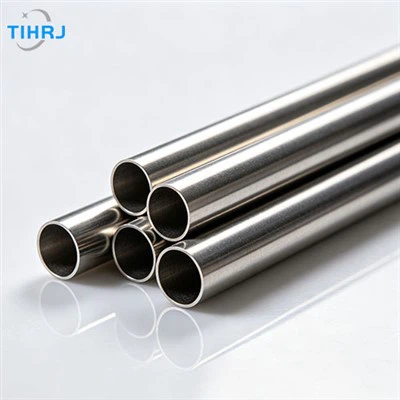
The development of titanium alloy exhaust pipes in the middle and rear sections is, to put it bluntly, an evolutionary history of "from track black technology to street trendy products". It neither deviates from the objective laws of material science, but always carries the unique "performance romanticism" of the modification circle. Today, let's take a look at this development process.
1. Beginning (Early 2000s)
The earliest batch of titanium exhaust pipes were basically used as "jewelry" for local tyrants' supercars. For example, the 2003 Chevrolet Corvette Z06 tested the titanium tailpipe - 40% lighter than stainless steel (18 pounds less per piece), and it is not afraid of rust, and the life is easily more than 15 years. But the problem is also naked: the cost of titanium raw materials is high, the processing is difficult, and it all depends on manual welding, and a pipe is tens of thousands of dollars large at every turn. At that time, the manufacturer shouted that "titanium can improve performance, fuel efficiency and durability", but ordinary car owners can only stare, after all, this price is enough to buy a second-hand car. But it proves two things: the lightweight of titanium is really fragrant, and the corrosion resistance is really useful, planting a seed for latecomers.
2. Technological Icebreaker (2010–2020s)
When the supercar brand saw the characteristics of this material, it was immediately moved: the car is one kilogram lighter, and the lap time is half a second faster! Bugatti made a big splash in 2020 - using 3D printing to make a titanium alloy tailpipe, with a wall thickness of less than 0.5mm, thinner than paper, but able to withstand thousands of degrees of exhaust gas. What's more, it is designed as an aerodynamic component that increases downforce to the rear of the car while exhausting, directly improving the stability of high-speed cornering. This has forced the titanium exhaust to full, and also made 3D printing technology officially enter the mainstream vision. During the same period, racing cars and high-end modifications (such as the Akrapovič "scorpion tube") began to use titanium exhaust as a selling point, and weight reduction, sound optimization, and high-rpm power improvement became signature labels.
3. Craft Revolution (Mid-To-Late 2020s)
Traditional welded titanium alloys are easy to deform, and the design is constrained. But as soon as 3D printing matured, the situation changed completely. In 2025, the American college team will use electron beam 3D printing (EBAM) to make a titanium alloy exhaust manifold, integrating the original winding pipeline into a compact integrated structure, directly cutting the length in half, and improving the exhaust efficiency of the engine. This technology can create an internal honeycomb structure, change the runoff channel, and even unify the two enemies of sound cancellation and performance. Bugatti and Porsche factories have also followed suit, evolving from "able to build" to "cleverly made".
4. Breaking The Circle Of Civilian Civilization (Around 2025)
In the past two years, titanium exhaust has suddenly become popular, and the key is two points: cost reduction (annual price reduction of titanium alloy by 8-10%) and process standardization. Manufacturers such as GV and TINOX have launched titanium alloy mid-tail sections for popular performance cars (such as Subaru STI), with precision casting + modular design, the cost is pressed to 10,000 yuan, the weight is still more than 30% lighter than stainless steel, and the horsepower can be squeezed out by 5-10 horsepower. What's even more attractive is the sound tuning - the titanium tube comes with a high-pitched metal voice, and the modification plant then targets the resonance noise to eliminate the resonant noise, so that the owner can "climax" when stepping on the accelerator. Even luxury brands like Bentley have come to an end, using titanium exhaust as a sports option, and officially entering the field of high-end street cars from the hard-core track.
In the past 20 years, the titanium exhaust pipe has taken the road of "top track→ supercar show-off→ technology decentralization→ modification and explosive models". It does not rely on metaphysics, but on real lightweight benefits and performance improvements. Nowadays, with the popularity of 3D printing and the declining cost of titanium alloys, even family car circles have begun to be greedy - don't be too surprised if you see a titanium alloy tail throat hanging on the back of the butt of a grocery cart one day in the future. If you want to know more about titanium exhaust, please contact catherine@hiriger.com.