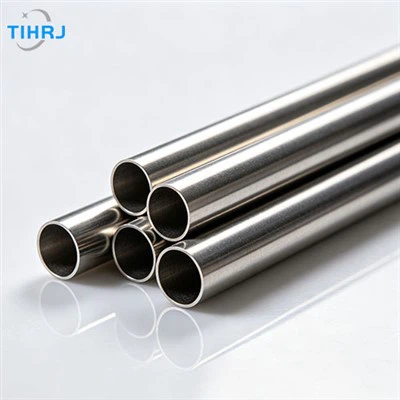
The core principle of anodizing discoloration of titanium tubes is a controlled electrochemical process rather than the addition of dyes. We can think of it as "growing" a transparent and hard oxide film – titanium dioxide – on the surface of titanium. This process takes place in an electrolyte, with a titanium tube acting as an anode (positive electrode) and a DC or pulsed voltage.
When an electric current passes through it, the titanium atoms on the surface of the titanium tube lose electrons and combine with the oxygen ions in the electrolyte, creating a very thin and dense film of titanium dioxide. The film itself is colorless and transparent, so where does the rich color we see come from? This is mainly due to the "thin film interference effect". It's like an oil film on the water after rain, or a bubble of soap that blows out, which takes on a colorful color. When natural light hits this extremely thin oxide film, part of the light is reflected directly on the surface of the film, while the other part penetrates the film and reflects again at the junction of the film with the titanium matrix. When these two beams of reflected light meet, light interference occurs. If two light crests meet the crests (in the same phase), the light of that wavelength is enhanced and we can see the color; Conversely, if the crest meets the trough (opposite phase), the light is weakened or even canceled out, and we cannot see the color. Since the thickness of the titanium dioxide film is on the same order of magnitude as the wavelength of visible light (about 400-700 nm), this interference effect is significant. By precisely controlling the thickness of the oxide film, it is possible to control which wavelengths of light are enhanced and which are weakened, resulting in specific colors. Voltage is the most critical factor in controlling film thickness: the higher the voltage, the stronger the driving force of the electric field, the thicker the oxide film formed, and the color of the interference will change from blue, golden yellow, and purple to darker shades (such as dark blue and green).
Stability Analysis Of Colors
The stability of the color of titanium tubes after anodizing is a critical concern, and it is influenced by a combination of internal and external factors.
From the perspective of internal factors, this titanium dioxide film itself has extremely high chemical inertness and mechanical strength. It bonds very firmly to the titanium matrix and is part of the titanium tube itself, not an adherence, so it is less prone to peeling problems like paint or plating. This film can also greatly enhance the corrosion resistance of titanium tubes, which is one of the reasons for its wide application in chemical and marine environments. Therefore, in the conventional environment of room temperature, no wear, and non-strong acid and alkali, the color produced by anodizing is quite stable and can be maintained for many years without significant fading.
However, its stability also has certain limitations. First, the color is less thermally stable. If the titanium tube is continuously heated above 300 degrees Celsius, the structure of the oxide film will begin to undergo crystal form transformation, resulting in small changes in film thickness and refractive index, resulting in color "drift" or darkening. At higher temperatures, the film layer can even fail completely. Secondly, there is mechanical wear. Although the oxide film is very hard, if it continues to rub and scratch with harder materials, it will locally reduce the thickness of the film layer, resulting in lighter color and even revealing the true color of titanium. Finally, chemical attack. Despite corrosion resistance, the oxide film may still be corroded and dissolved in a hot strong acid (e.g., hydrofluoric acid, concentrated sulfuric acid) or strong alkali environment, and the color will naturally disappear.
Key Factors That Affect Color Change
1. Voltage: This is the core and most direct control factor. Voltage is basically linearly proportional to oxide film thickness, and film thickness directly determines color. Therefore, in industrial production, the color number of the final product is precisely controlled by establishing a "voltage-color" mapping table. For example, low voltages (such as 10-15V) may produce light gold or blue, medium voltages (20-50V) may produce purple, dark blue, or green, and high voltages (above 60V) may produce dark green, brown, or even gray series.
2. Electrolyte Composition: The type, concentration, and pH of the electrolyte are crucial. The most commonly used is a dilute sulfuric acid solution, which provides good electrical conductivity and a moderate oxidation rate. However, different acids (such as phosphoric acid, chromic acid) or alkaline solutions, and even organic acids will affect the growth rate, porosity and microstructure of the film layer due to the catalytic or inhibiting effect of their anions on the oxidation process. Even at the same voltage, the optical properties of the layers produced in different electrolytes may vary slightly, resulting in slight differences in the final color.
3. Current Mode: The traditional constant voltage method is simple to operate, but more advanced constant current methods or pulsed power supplies can provide better control. Pulsed oxidation effectively dissipates heat generated during the reaction and gives the reactive ions time to diffuse, resulting in a denser, more uniform film layer, which is especially important for obtaining a product with a large area and uniform color.
4. Oxidation Time: Time mainly affects the integrity of film growth. In the initial stage, sufficient time is required for the film layer to grow to a stable thickness of the corresponding voltage. However, if the time is too long, the film may dissolve or become rough in some electrolytes, which will affect the uniformity and brightness of the color.
5. Titanium Tube Itself: The surface finish of titanium tube is the foundation. A highly polished mirror surface and a sandblasted matte finish will present a very different visual effect after undergoing the same anodizing. The surface of the mirror surface is bright and bright, like metallic paint; The matte surface is soft and elegant, more like an inherent color. In addition, the alloy composition and microstructure of titanium also have a subtle impact on the uniform growth of the oxide film.
In summary, anodizing of titanium tubes is a high-tech surface treatment technology that precisely "engraves" the thickness of the surface oxide film through electrochemical methods and uses the principle of light interference to present color. Its color is brilliant and firmly bonded to the matrix, providing excellent daily stability. However, achieving the desired uniform and long-lasting color results requires systematic and precise control of a range of factors such as voltage, electrolyte, time, and material surface condition.