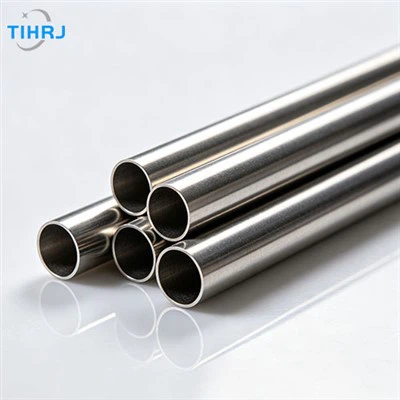
Titanium Seamless Pipe Rolling Process
The manufacturing essence of titanium seamless pipe is to convert solid titanium billet into a hollow tube body through multi-stage plastic deformation without welds. The process begins with titanium alloy round ingots (such as Gr.2 or Gr.5), which are first heated to 850-950°C (near the β phase change point) in an inert atmosphere or vacuum environment to improve the plasticity of titanium and reduce deformation resistance. Then it enters the hot perforation stage - the hot ingot billet is sent to the oblique rolling perforator, and under the combined action of the high-speed rotation of the conical roll and the axial propulsion of the ejector, it is forced to penetrate the center to form capillaries with uneven wall thickness. After perforation, the capillary is immediately transferred to the hot rolling sizing process, typical equipment such as three-roll Asel rolling mill or two-roll oblique rolling extension machine, the capillary is gradually reduced and extended under the coordinated rolling of the roll hole type and the internal top head, titanium is easy to cause temperature drop due to fast heat conduction at this stage, often needs secondary heating and spraying lubricant to reduce friction; The hot-rolled semi-finished pipes are pickled (HF-HNO₃ mixture) to remove the scale and transfer to the core link of cold rolling finishing - using cyclic cold rolling mills (such as Pilger mills) or multi-roll continuous rolling mills, at room temperature through the combination of mold and mandrel extrusion to achieve up to 80% section reduction rate, due to the significant work hardening index of titanium (n-value≈ 0.15-0.2), each pass of cold deformation needs to be annealed at 700-800°C intermediate vacuum to restore plasticity; The final tube is optimized by solution treatment + aging (for α + β alloys) to optimize the structure, and then through tension straightening and non-destructive testing (ultrasonic/eddy current) to ensure dimensional tolerance (±0.05mm) and mechanical properties (e.g., ASTM B338 requires tensile strength ≥345MPa). If you want to know more about titanium tubes, please contact catherine@hiriger.com.
Process Difficulties: The poor thermal conductivity of titanium at low temperature (≈7 W/m·K) leads to a large temperature difference between inside and outside during rolling; cold rolling needs to strictly avoid iron pollution and intergranular corrosion; argon gas protection is required throughout the process to prevent high-temperature hydrogen absorption and embrittlement.
Titanium Welded Pipe Rolling Process
The core of titanium welded pipe is to bend and form a continuous roll of titanium strip coil and weld it into a pipe, which is suitable for thin-walled and efficient production. The starting point of the process is cold-rolled titanium strip coil (thickness 0.1-5mm), after uncoiling, multiple sets of straightening rollers are used to eliminate the residual stress of rolling, and then enter the chemical or electrolytic cleaning line to remove the surface grease and oxide film (the melting point of the oxide layer of titanium is as high as 1640°C, and if not cleaned, it will lead to welding defects); The clean titanium strip is then entered into the precision roll bending system, which is gradually bent into an open circle ("O" shape) or oval shape by 12-24 groups of gradient hole rolls, and the roll gap needs to be dynamically compensated according to the elastic modulus of titanium (110GPa) and rebound characteristics (rebound angle ≈ 3°-8°). The formed open pipe billet immediately enters the welding unit, using inert gas protection tungsten argon arc welding (TIG) or high-energy beam welding (plasma/laser): TIG welding uses a non-consumable tungsten electrode to melt the pipe seam in an argon gas atmosphere, with a welding speed of about 5-20m/min and a heat-affected zone width of about 2-4mm; laser welding focuses the beam in the micron-level area, the penetration depth is controllable and the heat-affected zone is as narrow as 0.1mm, the welding speed can reach more than 50m/min, and the weld strength coefficient exceeds 95% (the standard for seamless pipes is 100%). After welding, the pipe body is directly heated to 750-850°C by induction heating to 750-850°C under the protection of inert gas shield for solution treatment, eliminating β phase coarsening and martensitic brittleness caused by welding. Then enter the sizing frame, and fine-tune the outer diameter (tolerance ±0.1mm) by 3-5 sets of fine rolls and improve the roundness. Finally, the length is cut and determined by fly saw, and the defects such as porosity and inclusions of the weld are detected by automatic eddy current detection or X-ray imaging.
Process Core: The purity of welding shielding gas needs to be ≥99.999%; Roll bending forming needs to be mathematically modeled to optimize the roll sequence (such as COPRA software); Thin-walled welded pipes (δ/D≤1%) rely on tension reduction technology to prevent instability and wrinkling.
Titanium seamless pipes form a uniform structure along the axial streamline due to the plastic deformation of the whole process, and have isotropic mechanical properties (especially circumferential strength), which are suitable for high pressure (≥30MPa), strong corrosion (such as seawater acidification environment) and fatigue-sensitive scenarios (such as aviation hydraulic pipes). Its limitations are large equipment investment (single line cost exceeds 200 million yuan), low yield (≤50%) and high lower wall thickness limit (usually ≥ 1mm). Titanium welded pipes can reduce costs by 30-50% in the fields of thin wall (0.1-0.5mm) and large diameter (φ≤610mm) by virtue of the advantages of efficient and continuous production (yield >85%), but there is a tissue gradient in the weld area (the hardness of the fusion area increases by about 10-20HV), and the pressure bearing capacity is about 80-90% of that of seamless pipes, so it is mostly used in lightweight scenarios such as low-pressure heat exchangers and medical catheters. Modern technology trends show that laser welding + solution treatment is gradually narrowing the performance gap between welded pipes and seamless pipes, while isothermal rolling + deformation heat treatment (such as Ti-3Al-2.5V seamless pipes) continues to improve the pressure limit of high-end seamless pipes.