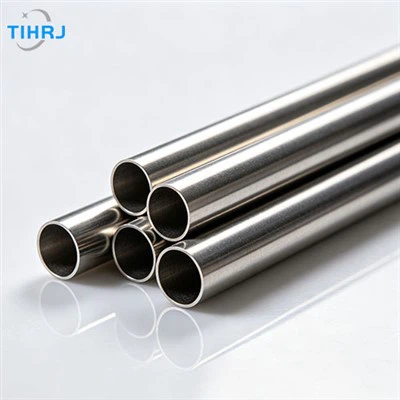
Titanium, the futuristic-sounding metal, plays a pivotal role in chemical, aerospace, and marine engineering. It is as light as aluminum and stronger than steel, and has a corrosion-resistant "golden bell". However, it is this "golden bell" that makes its welding, especially repair welding, into an extremely delicate "surgical operation" that does not tolerate the slightest sloppiness. Re-welding a titanium pipe is far from simply filling the hole, but a precise dialogue with "delicate metals", which requires the welder to complete it with experience, patience and absolute awe.
The success of titanium pipe repair welding depends on preparation. When you get a titanium pipe that needs to be repaired, the first step is never to start welding directly. Just like a doctor needs to debride and disinfect before surgery, we must first do a thorough "physical examination" and "cleaning" of the titanium tube. First of all, accurately locate the defects, and use an angle grinder with a special grinding wheel to completely remove cracks, sand holes or corrosion pits until the intact metal color is revealed. This bevel should be sanded smoothly and cleanly, without any sharp corners, in order to provide a perfect "breeding ground" for subsequent welding. Immediately afterwards, it is crucial to clean. Titanium is extremely "hungry" for oxygen, nitrogen, and hydrogen at high temperatures, and the slightest pollution can cause welds to become brittle and crack. We must carefully wipe at least 50 mm on both sides of the groove with a special solvent that does not contain chloride ions, such as acetone, without leaving even grease on the fingers. After the polishing and cleaning are completed, the area to be welded must not be touched with bare hands, which is the tacit rule of welders.
If cleaning is the "cure", then creating an absolutely pure welding environment is the "root cause". The core secret of titanium pipe repair welding lies in "gas protection". Not only do we have to drag an argon "tail" behind the torch to protect the melt pool, as we do in normal welding, but we also have to create an argon-filled "shelter" for the back and around the weld. Typically, we make a special "drag cover" based on the pipe diameter, which moves closely with the torch to ensure that the red area that has been welded but is still hot is always covered with argon until it cools below a safe temperature. For the inside of the pipeline, it is necessary to make a plug or an overall argon charging system according to the structure to completely replace the air in the pipe with argon gas with a purity of more than 99.999%. Before welding, the gas must be precisely controlled with a flow meter and pre-inflated for a period of time to ensure that every inch of air is expelled. This invisible "argon tent" is the only barrier to protect the pure life of titanium pipe welds.
When everything is ready, the real "operation" begins. The pursuit of repairing and welding titanium pipes is not fast, but stable and accurate. We usually choose titanium wires with higher purity, and the diameter should not be too thick. Welding parameters – current, voltage, speed – are determined by precision calculations and tests, usually with a small line energy to avoid excessive heat input. At the moment of arcing, the welder should be like a micro-carving artist, concentrating. The arc smoothly cuts through the argon layer, creating a bright and clear melt pool between the base metal and the welding wire. This melt pool should be like a small mirror, bright and stable. The welding torch should not swing too much, but should move steadily and at a uniform speed to ensure that the front and rear of the melt pool are always under the effective protection of argon. Once any abnormality in the color of the melt pool is found, such as white or blue traces, it means that the protection has failed, the gas is contaminated, and it must be stopped immediately and re-polished and cleaned. During the whole process, the welder almost held his breath, relying on muscle memory and eye insight to complete a precise metallurgical combination in an instant spark.
The welding is over, the arc is extinguished, but the work is far from over. At this time, the delivery of the shielding gas must not be stopped. The inflation of the tail cover and back of the welding gun needs to be continued for a while until the weld area completely changes from a dazzling bright white to the silvery white color of the metal itself, and the temperature drops to the touch of the hand without feeling hot. This process is called hysteresis aspiration, which is to prevent the high-temperature weld from oxidizing by air during the cooling process. After the weld cools, we have to conduct a strict "review" inspection. The first is the most intuitive visual inspection, a qualified titanium weld with a surface that should be bright silvery-white or light straw yellow, which indicates a successful protection. If there is a blue, gray or even white oxide film, then this repair weld is a failure. Next, use coloring penetrant detection to check whether there are any microcracks and pores on the surface. For critical pipelines, radiographic testing (RT) is also required to detect internal defects such as non-fusion and slag inclusions. Only after passing all these tests can this titanium tube be truly "reborn".
All in all, the repair welding process of titanium pipes is a unique skill that combines material science, physics knowledge and manual effort. There are no earth-shattering scenes, only the demanding of details, the adherence to the process, and the deep understanding of the material's properties. Every successful repair weld is the crystallization of the welder's experience and inner awe. The repaired titanium tube continues to serve silently in the harsh environment in the future, which is the most silent and noble praise for this delicate "operation".