


Can 'bend' be used in a passive present perfect continuous tense? This is a question that not only piques the curiosity of language enthusiasts but also has practical implications in the business world, especially for a bend supplier like myself. In this blog post, we'll explore the grammatical aspect of using 'bend' in the passive present perfect continuous tense, and then connect it to our work in supplying high - quality bends.

The Grammatical Analysis
Let's first understand the structure of the present perfect continuous tense. In the active form, it is constructed as "have/has been + verb (present participle)". For example, "I have been working on this project for two days." When we transform a sentence into the passive voice, the focus shifts from the doer of the action to the receiver of the action.
The passive form of the present perfect continuous tense is less common, but it exists. It is formed as "have/has been being + past participle". Now, let's consider the verb 'bend'. The base form is 'bend', the past tense is 'bent', and the past participle is also 'bent'.
An example of using 'bend' in the active present perfect continuous tense could be: "The workers have been bending the metal tubes all morning." To convert it into the passive present perfect continuous tense, we get: "The metal tubes have been being bent by the workers all morning."
However, this passive construction is often avoided in modern English because it sounds rather cumbersome and wordy. In most cases, we can use the passive present perfect tense instead. For instance, "The metal tubes have been bent by the workers." The passive present perfect continuous tense is mainly used when we want to emphasize the ongoing nature of the action in the past up to now and the passive relationship between the object and the action.
Bends in the Supply Business
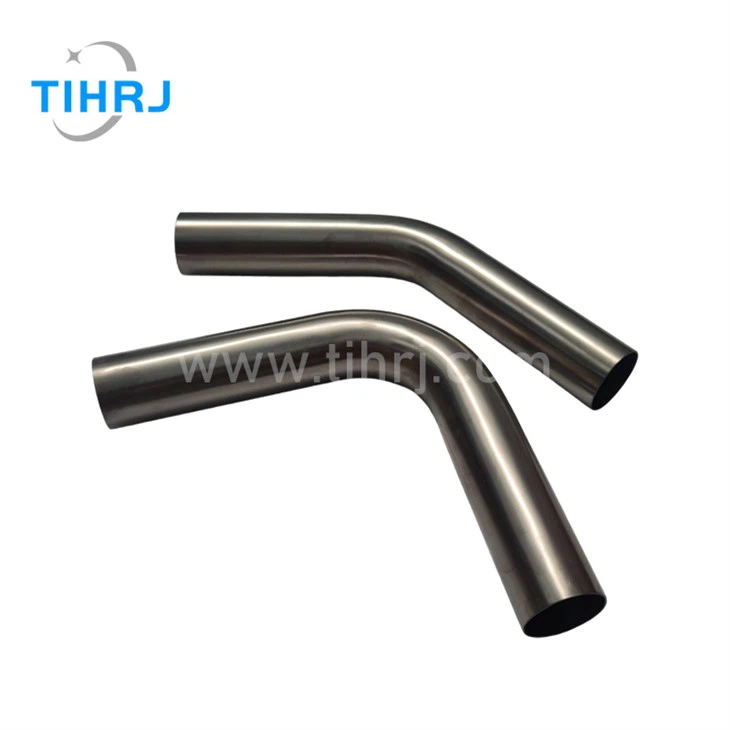
As a bend supplier, our focus is on providing top - notch bending products to various industries. We offer a wide range of bends, including 2.5″ Titanium 90 Degree Mandrel Bend, Titanium 90° Mandrel Bend, and Titanium 45° Mandrel Bend.
These mandrel bends are crucial components in many fields, such as automotive exhaust systems, aerospace engineering, and industrial piping. The manufacturing process of these bends involves a lot of bending operations. The raw materials, like titanium tubes, have been being bent by our advanced machinery and skilled workers to meet the strict specifications of our clients.
In the automotive industry, for example, the exhaust system requires precise bends to ensure optimal gas flow and performance. Our 2.5″ Titanium 90 Degree Mandrel Bends are crafted with great precision to fit perfectly into the exhaust systems of high - performance vehicles. The titanium material offers excellent corrosion resistance and high - temperature tolerance, making it an ideal choice for automotive applications.
In the aerospace sector, the requirements for bends are even more stringent. The Titanium 90° Mandrel Bend and Titanium 45° Mandrel Bend are used in the construction of aircraft engines and hydraulic systems. The continuous bending process, which could be described in the theoretical passive present perfect continuous tense as "The titanium tubes have been being bent to meet the aerospace - grade quality standards", requires strict quality control at every step.
Quality Control and Assurance
To ensure the quality of our bends, we have a comprehensive quality control system in place. Our team of experts has been monitoring the bending process continuously. Raw materials are carefully inspected before the bending begins, and the finished products undergo a series of rigorous tests.
The bending operation is carried out using state - of - the - art machinery. The machines are programmed to achieve the exact bend angles and radii required by our customers. Our workers are highly trained and have been working on perfecting the bending techniques for years.
As an ongoing process, the bends have been being improved to incorporate the latest technological advancements. We are constantly researching and developing new bending solutions to meet the evolving needs of our clients from different industries.
Importance of Communication in the Supply Chain
In addition to producing high - quality bends, effective communication is crucial in the supply chain. We understand that our clients rely on us to provide them with the right products at the right time. Our sales team has been communicating with customers regularly to understand their requirements and provide them with the best possible solutions.
If you are in the automotive, aerospace, or any other industry that requires high - quality bends, we are here to serve you. Our professional staff can answer your questions regarding the product specifications, prices, and delivery times. We believe that by maintaining open and transparent communication, we can build long - term partnerships with our clients.
Conclusion
In conclusion, while the use of 'bend' in the passive present perfect continuous tense is grammatically correct but less common in modern English, it can be related to the real - world processes in our bend supply business. The continuous and ongoing bending operations involved in the production of our high - quality bends, such as the 2.5″ Titanium 90 Degree Mandrel Bend, Titanium 90° Mandrel Bend, and Titanium 45° Mandrel Bend, reflect the importance of precision and quality control in our industry.
If you are interested in purchasing our bends or have any inquiries, please feel free to contact us for a procurement discussion. We look forward to working with you to meet your specific needs.
References
- Swan, M. (2016). Practical English Usage. Oxford University Press.
- Celce - Murcia, M., & Larsen - Freeman, D. (1999). The Grammar Book: An ESL/EFL Teacher's Course. Heinle & Heinle.


